.png)
Japanese Double Reinforced Expansion Joints for Industrial Piping Systems

Updated: Sep 16
Nichiboku's industrial Insights
Introduction
Industrial piping systems exposed to temperature changes require controlled accommodation of thermal expansion and contraction. When these movements are not properly considered, piping loads may be transferred to flanges, equipment nozzles, supports, and connected machinery.
The Japanese Double Reinforced Expansion Joints from OSAKA RASENKAN KOGYO CO., LTD. incorporates two metallic bellows sections within a mechanically reinforced assembly. This configuration provides model-specific axial displacement capacity for demanding industrial piping applications.
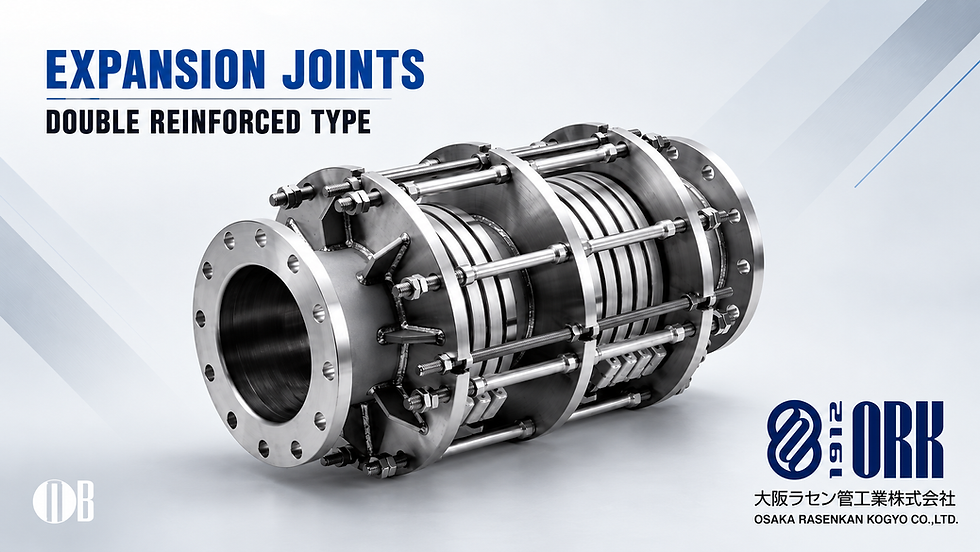
Japanese Double Reinforced Expansion Joints Configuration
The assembly combines two bellows elements, connecting sections, reinforcement structures, and external rods within a single engineered unit.
This configuration is designed to:
Accommodate controlled axial piping movement
Distribute movement between two bellows sections
Support structural stability across the complete assembly
Provide defined displacement and spring-rate characteristics
Adapt to different pipe diameters and installation requirements
Expansion joints must be selected as part of the complete piping system. Pressure, temperature, fluid, movement, fatigue cycles, anchors, guides, flange standards, and installation length must all be technically evaluated.
Standard Technical Range
Parameter | Manufacturer’s Standard Specification |
Manufacturer | OSAKA RASENKAN KOGYO CO., LTD. |
Product Type | Double Reinforced Expansion Joint |
Model Range | 2C-50 to 2C-600 |
Nominal Diameter | 50A to 600A |
Standard Design Pressure | 1.0 MPa |
Standard Bellows Materials | SUS304 or SUS316L |
Alternative Materials | Available subject to technical evaluation |
Reference Flange Standard | JIS 10K |
Reference Temperature | 300°C |
Reference Design Life | 3,000 cycles or more |
Axial Displacement | Model-dependent |
The stated temperature and design-life conditions are based on the manufacturer’s reference calculation using SUS304 bellows. Final performance must be confirmed according to the required model, material, pressure, temperature, movement, and operating cycle.

Industrial Applications
Double reinforced expansion joints may be evaluated for piping systems used in:
Power generation and utility plants
Chemical and petrochemical facilities
Oil and gas processing systems
Marine and shipboard piping
Mining and mineral-processing plants
Steam, hot-water, and thermal-fluid lines
Industrial process and auxiliary piping
They may be suitable for new piping projects, scheduled maintenance, system modification, or replacement of existing Japanese expansion joints when the original operating and dimensional requirements can be identified.
Information Required for Technical Selection
Selection Requirement | Information to Provide |
Pipe Size | Nominal diameter and pipe dimensions |
Connections | Flange standard, rating, and facing |
Operating Conditions | Normal and maximum pressure and temperature |
Fluid | Medium, concentration, and corrosion characteristics |
Movement | Required axial displacement and movement direction |
Service Cycle | Estimated number and frequency of operating cycles |
Dimensions | Required face-to-face or overall installation length |
Piping Arrangement | Location of anchors, guides, supports, and connected equipment |
Material | Bellows, pipe, flange, and structural material requirements |
Replacement Unit | Nameplate, drawing, photographs, and existing model number |
A dimensional match alone is insufficient. The replacement must also be evaluated against the original pressure, movement, spring rate, material, temperature, and piping-restraint conditions.
International Sourcing from Japan
Nichiboku supports international industrial users, engineering companies, maintenance contractors, and procurement departments with:
Product and model identification
Technical specification coordination
Manufacturer quotation management
Replacement requirement evaluation
Export documentation and international supply
Japanese Industrial Products
Review Nichiboku’s virtual catalogue of Japanese industrial equipment and components for plant maintenance, replacement requirements, and defined industrial projects worldwide.
https://www.nichiboku.com/japanese-industrial-products https://www.nichiboku.com/japanese-industrial-products/osaka-rasenkan-kogyo


Comments