.png)
Applying Ikigai to Industrial B2B Platform Strategy

Updated: Apr 4
Welcome to Nichiboku's industrial Insights
A practical model for building buyer clarity, technical trust, and commercial direction
Introduction
Ikigai is usually explained as a personal concept. In a business context, however, its structure can be useful in another way.
For an industrial B2B platform, the value is not philosophical. It is strategic. The platform works better when four things are aligned: what the company is genuinely built to solve, what it can execute well, what the buyer actually needs, and what can become measurable business value.
That is especially relevant in industrial and cross-border environments, where buyers do not need more noise. They need clarity.
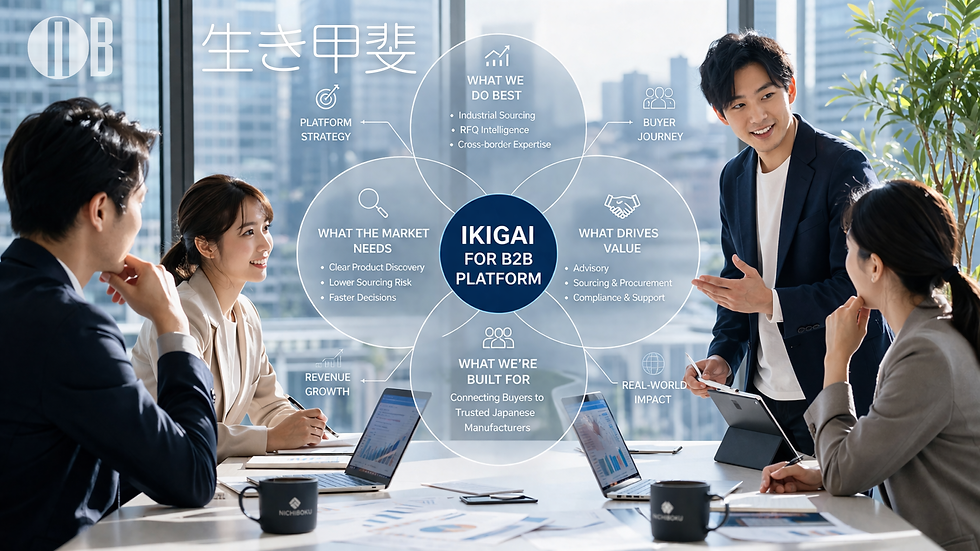
Traditional Ikigai and its B2B reinterpretation
The original Ikigai idea connects meaning, capability, need, and livelihood. In platform strategy, that same logic can be reinterpreted more practically.
Traditional Ikigai | Personal Meaning | B2B Reinterpretation | Platform Application |
What you love | What gives personal fulfillment | What the business is genuinely committed to solving | positioning, sector focus, content direction |
What you are good at | Personal strength | What the business can execute with credibility | technical guidance, sourcing flow, RFQ structure |
What the world needs | Social value | What the market is actively struggling with | buyer pain points, qualification logic, solution paths |
What you can be paid for | Livelihood | What can be monetized in a scalable way | advisory, sourcing support, compliance-related services |
The intersection | Life direction | Commercial alignment | trust, conversion, lead quality, revenue logic |
The point is not to redefine Ikigai. It is to use its logic to test whether a platform is commercially coherent.
Why this matters in industrial B2B
Many industrial B2B platforms strategy look complete but operate weakly. They show products, publish content, and describe services, yet they do not help the buyer move forward.
That gap is costly.
Common Platform Weakness | Commercial Result |
Too much information without guidance | Buyer confusion |
Product pages without qualification logic | Low-quality inquiries |
Technical content without commercial next step | Weak conversion |
Generic positioning | Low trust and weak differentiation |
In industrial trade, a platform should do more than present information. It should reduce friction.
A more Nichiboku-oriented interpretation: Industrial B2B platform strategy
For a company operating between international buyers and Japanese manufacturers, platform logic has to be more disciplined.
A platform in this space should help buyers:
understand what type of product or supplier path fits their case
prepare clearer RFQs
reduce technical ambiguity before quotation stage
understand whether market-entry or compliance support is needed
move from inquiry to a more qualified commercial discussion
That is where the reinterpretation becomes useful.
For Nichiboku, the platform is not just a catalog. It functions as a technical-commercial bridge between industrial need and cross-border execution.
The four layers in real platform terms
Layer | Key Question | Strategic Interpretation | Platform Execution |
Capability | What can the business actually execute well? | Core operational strength in sourcing, technical-commercial interpretation, and documentation flow | sourcing coordination, RFQ structuring, requirement filtering |
Market need | What is the buyer really trying to resolve? | Reduction of uncertainty across specifications, supplier access, and cross-border complexity | buyer qualification paths, problem-based navigation, solution framing |
Platform function | What should the site actually do? | Act as a guide and filter, not just a catalog | integrated content, solution pages, RFQ logic, advisory pathways |
Revenue logic | Where is the value captured? | Monetization beyond product supply through structured services | sourcing support, advisory, compliance guidance, market-entry services |
From concept to industrial execution
A stronger industrial platform usually aligns these elements:
Platform Layer | Role |
Content | educates and attracts the right audience |
Qualification | improves RFQ clarity and buyer readiness |
Guidance | reduces confusion in technical and commercial steps |
Conversion | moves the visitor toward inquiry, diagnosis, or consultation |
Monetization | connects demand with real service or supply value |
This is what gives a platform direction instead of just presence.
Conclusion
Used this way, Ikigai stops being a lifestyle concept and becomes a business filter.
For industrial B2B platforms, that filter is useful because it forces alignment between expertise, buyer need, RFQ structure, and monetizable value.
For Nichiboku, that means a platform designed not only to inform, but to guide industrial buyers more clearly through sourcing, technical decision-making, and Japan-related commercial pathways.
That is where the concept becomes practical.
Suggested CTA Block
Need a clearer industrial B2B platform structure?Explore how sourcing logic, RFQ guidance, and Japan market-entry support can be integrated into a stronger digital framework.
Nichiboku Worldwide Supply Support
Nichiboku Ltd. provides global supply support for Japanese industrial products, ensuring reliable distribution and after-sales assistance worldwide.
➡️ Get global supply support
➡️ Inquire about international shipping and product availability
➡️ Partner with Nichiboku for worldwide industrial solutions


Comments