.png)
Okazaki RESIOPAK® Resistance Thermometer Sensors — Identification and Replacement Information

Introduction
Okazaki Manufacturing Company produces RESIOPAK® mineral insulated resistance thermometer sensors for industrial temperature measurement. RESIOPAK® is Okazaki's trademark for its metal-sheathed resistance thermometer sensor construction.
The sensor consists of a stainless-steel sheath containing the resistance thermometer element and conducting wires, with magnesium oxide (MgO) inorganic insulation packed between the internal components and sheath.
For replacement procurement, confirming only that an existing instrument is a Pt100 sensor is generally insufficient. The model, resistance element, accuracy class, wiring configuration, sheath dimensions, temperature range and installation arrangement should be identified before replacement compatibility is evaluated.
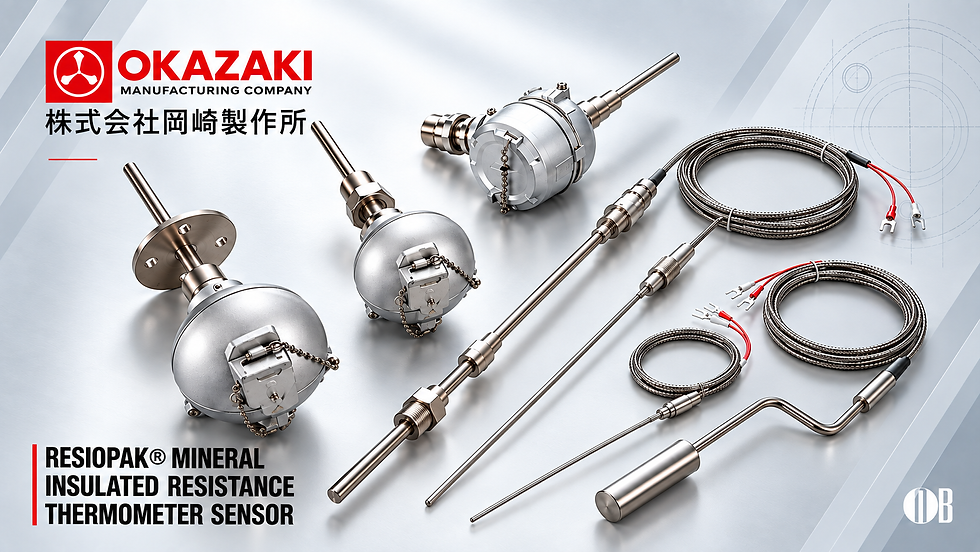
Technical Overview: Okazaki RESIOPAK Resistance Thermometer Sensor
RESIOPAK® uses a compact mineral-insulated construction for industrial temperature measurement. Okazaki documents multiple sheath sizes, wiring configurations, temperature categories and basic models for different measurement and installation requirements.
Technical Item | Okazaki RESIOPAK® Configuration / Description |
Product Category | Mineral insulated / sheathed resistance thermometer sensor |
Basic Construction | Stainless-steel sheath, conducting wires, resistance thermometer element and compacted magnesium oxide (MgO) insulation |
Resistance Element | Pt100Ω; winding and thin-film resistance element constructions are documented |
Accuracy Classes | AA, A, B and C, subject to the applicable element construction and standard |
Applicable Standards | JIS C 1604 / IEC 60751 and ASTM E1137 configurations are documented |
Wiring Configurations | 2-wire, 3-wire and 4-wire connection methods |
Standard Sheath Material | 316 stainless steel in the documented standard specification |
Sheath Diameter Range | Manufacturing range from φ0.8 to φ12.75 mm |
Temperature Categories | L: −196 to +100°C; N: −30 to +200°C; M: 0 to +350°C; H: 0 to +500°C |
Basic Models | R35, T110/R110, R96N, R97N and R99N |
Installation Characteristics | Small sheath diameter, low thermal capacity and bendable construction; minimum bend radius is two times the sheath outside diameter, excluding the 70 mm tip section |
The required combination of resistance element, accuracy, wiring, sheath dimensions, temperature category and installation configuration should be verified from the existing model code and technical documentation rather than inferred from external appearance.
Industrial Application
RESIOPAK® sensors are used for industrial temperature measurement where a compact sheathed sensor construction, response to temperature changes or installation flexibility is required.
Okazaki documents configurations for indoor installations, general outdoor environments and hazardous locations. Specific configurations are also available for environments where explosive gases may occur, including petroleum refining and petrochemical installations.
Selection should therefore be based on the actual measurement range, required accuracy, process environment, installation geometry, wiring arrangement and applicable installation requirements.

Identification / Replacement Considerations
When evaluating an existing Okazaki RESIOPAK® sensor for replacement, the complete installed configuration should be identified.
Priority information includes:
Manufacturer and exact model / model code
Resistance element and nominal resistance
Accuracy class
2-wire, 3-wire or 4-wire configuration
Single or double element configuration, where applicable
Existing nameplate or identification markings
Copy of the original drawing, when available
Sheath material and outside diameter
Insertion length and overall length
Process or mounting connection
Terminal head, lead wire or connector configuration
Required temperature range
Operating environment / hazardous-area requirement, when applicable
Applicable standard, when specified
Quantity
A sensor with a similar external configuration should not automatically be considered interchangeable. Differences in sheath diameter, insertion length, resistance element, wiring, process connection or installation configuration can affect compatibility with the existing installation.
Information Recommended for Quotation
For an Okazaki RESIOPAK® RFQ, provide the complete model code whenever available.
If the model code cannot be confirmed, provide clear photographs of the nameplate and complete sensor, together with a copy of the original drawing, Pt100 configuration, accuracy class, number of conducting wires, sheath diameter and length, process connection, operating temperature, quantity and required quotation deadline.
For structured preliminary model identification, use the:
Okazaki Model Code Generation Apphttps://www.nichiboku-mkt.com/okazaki-model-code-identifier/
The application can be used to organize available technical information before submitting an RFQ. Final product identification and quotation feasibility remain subject to technical review.
Nichiboku Support
Nichiboku supports international sourcing and supply of identifiable Japanese industrial equipment and instrumentation, including Okazaki resistance thermometer sensors and industrial temperature measurement products.
For replacement requirements, technical evaluation is based on the available information for the installed equipment and required configuration. Providing the exact model code, nameplate information and a copy of the original drawing helps reduce identification uncertainty and supports a technically qualified RFQ.
Okazaki Manufacturing — Nichiboku Techhttps://www.nichiboku.com/japanese-industrial-products/okazaki-manufacturing
For replacement or procurement evaluation, provide the manufacturer, exact model number or model code, copy of the original drawing or nameplate, technical specifications, quantity and required quotation deadline.


Comments