.png)
Sourcing Japanese Replacement Equipment & Spare Parts for Existing Plants

Nichiboku's industrial Insights
Introduction
When Japanese industrial equipment requires replacement, the first challenge is not obtaining a quotation. It is confirming exactly what is installed.
A manufacturer name or general product description is rarely sufficient. Correct identification may depend on the complete model code, part number, nameplate, technical drawing, equipment photographs and existing installation data.
This is particularly important for power generation, oil and gas, petrochemical, mining, marine, water and general industrial plants operating Japanese equipment.
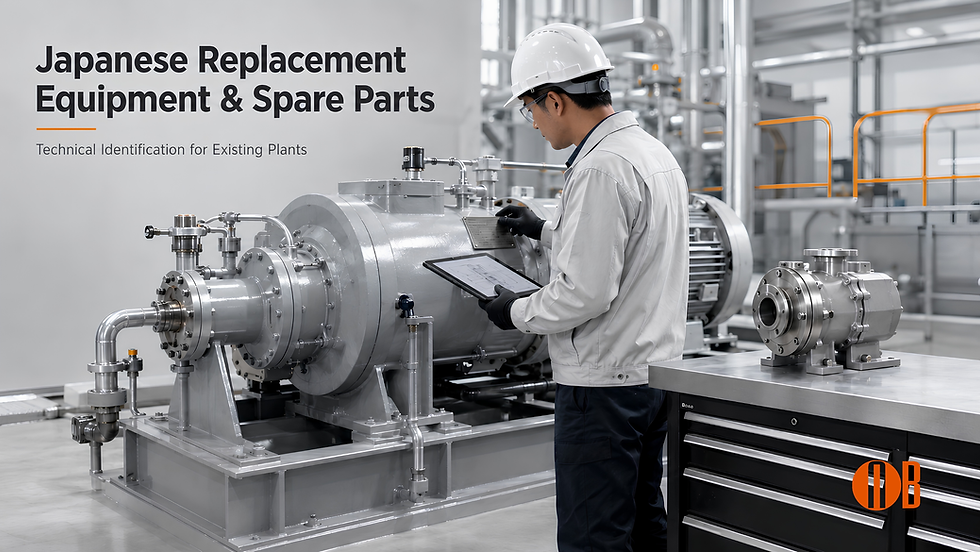
Installed-Base Sourcing Begins with Identification: Japanese replacement equipment.
Industrial equipment may remain in operation for many years. During that period, documentation can become incomplete, product series may change and original procurement records may no longer be readily available.
A replacement requirement should therefore establish:
Manufacturer.
Complete model or part number.
Serial number, when available.
Nameplate information.
Technical drawing.
Required quantity.
Existing installation and operating conditions.
In replacement sourcing, the model code forms part of the technical specification. Missing letters, numbers or suffixes can affect materials, dimensions, connections, ratings or configuration.
Exact Replacement, Successor Model or Alternative
An installed-equipment requirement may involve three different sourcing paths:
Exact replacement: The same recognized model, part number and configuration, subject to current confirmation.
Possible successor model: A newer product that may have replaced an earlier series but still requires technical comparison.
Technical alternative: A different product considered only after compatibility has been reviewed and accepted by the responsible engineering team or end user.
A visually similar component should not be assumed to be technically interchangeable.
Manufacturer and Supply-Channel Verification
Identifying the manufacturer does not automatically confirm availability.
Certain products may have been custom-manufactured, supplied for a specific project, discontinued, modified for another equipment manufacturer or restricted to an established distribution channel.
The sourcing assessment must therefore distinguish between:
Manufacturer identification.
Product and configuration confirmation.
Current supply-channel feasibility.
Technical documentation availability.
Commercial and export feasibility.
How Nichiboku Evaluates Replacement Requirements
Nichiboku evaluates Japanese replacement equipment and spare-part requirements through technical identification, document review and Japan-side supply-channel verification.
The evaluation is based on the information provided by the customer. Where identification is incomplete, additional drawings, nameplate photographs or installation information may be required.
Nichiboku does not assume product equivalence, current availability or international supply feasibility without sufficient confirmation.
Submit a Japanese Equipment Sourcing Request
For an initial evaluation, provide:
Manufacturer → Model → Part Number → Nameplate → Drawing → Equipment Photographs → Quantity → End User or Plant → Delivery Country
Related Insight
After the equipment has been identified, quotation and manufacturing requirements must be aligned with the procurement plan.


Comments